
Top Signs You Need Garage Door Service – Don’t Ignore These
A garage door that takes one second longer to open than it did last month isn’t aging gracefully. It’s telling you the spring tension has dropped and the opener motor is compensating by overworking. Catch that signal early and you replace a spring. Miss it and you replace a spring and a motor. Most homeowners wait for the dramatic failure, the door that won’t budge or the loud bang. The signs worth catching come first, and they’re quieter. Here’s what your door is telling you, and how to hear it before small money turns into big money.
If you’d rather not crawl around the tracks with a flashlight, call (855) 506-5081 for a free estimate. We’ll tell you what’s worn and what can wait.
What Does the Manual Balance Test Tell You About Your Springs?
The manual balance test is the single best check a homeowner can do, and it takes about two minutes. Pull the release cord to disconnect the opener, lift the door by hand to about waist height, and let go. A balanced door holds that position or settles only slightly. A door with weak springs drifts back down, and that drift is a red flag, not a personality quirk.
Here’s why it matters. Torsion and extension springs carry the weight of the door. When they lose tension, the opener motor takes on that weight instead. That’s the one-second delay you notice, and it’s the motor working harder than it was built to. Left alone, the motor heats up, the gears wear, and eventually you’re paying to fix both the spring and the opener.
A door that drifts down when half-open is spring-deficient. A door that feels heavy to lift by hand is the same story from the other direction. Both point to spring work, and spring work is not a homeowner job. Torsion springs sit under extreme tension, and a spring that lets go while you’re near it can cause serious injury. This is the one check we want you to do, and the one repair we want you to leave to a trained technician. In Edison, door systems that sit through humid summers and cold snaps cycle through real expansion and contraction, and springs feel that wear.
- Door won’t hold position: springs are losing tension.
- Door feels unusually heavy: the springs aren’t carrying their share.
- Door slams down when released: stop using it and call for service.
What Is Your Door Trying to Tell You With That Sound?
Every garage door failure has a soundtrack, and the sound points to the part. Learn to tell three apart and you’ll know roughly what you’re facing before anyone opens a toolbox.
- Grinding: usually a roller bearing seizing or a dry hinge. A grinding roller is often weeks from locking up, and a stuck roller drags the door off its track.
- Scraping: the door panel is rubbing the track, often after a knock or a loose track bracket. Left alone, it scores the panel and the track both.
- Slapping or popping: a cable that’s come loose from its drum, or a stretched spring. Cables are under tension too, and a slack or frayed cable is a stop-using-it signal.
We work on your exact system, so when a LiftMaster or a Wayne Dalton door makes a particular noise, we know where to look first. The sound a Craftsman opener makes when its trolley is worn is different from the sound of a failing logic board, and diagnosing it correctly the first time saves you from replacing parts that were never the problem. In Edison, where plenty of homes still run older openers alongside newer doors, that brand familiarity matters. If a noise has started and stayed, that’s your door asking for garage door repair before the part fails outright.
Why Does Visual Asymmetry Matter More Than You’d Think?
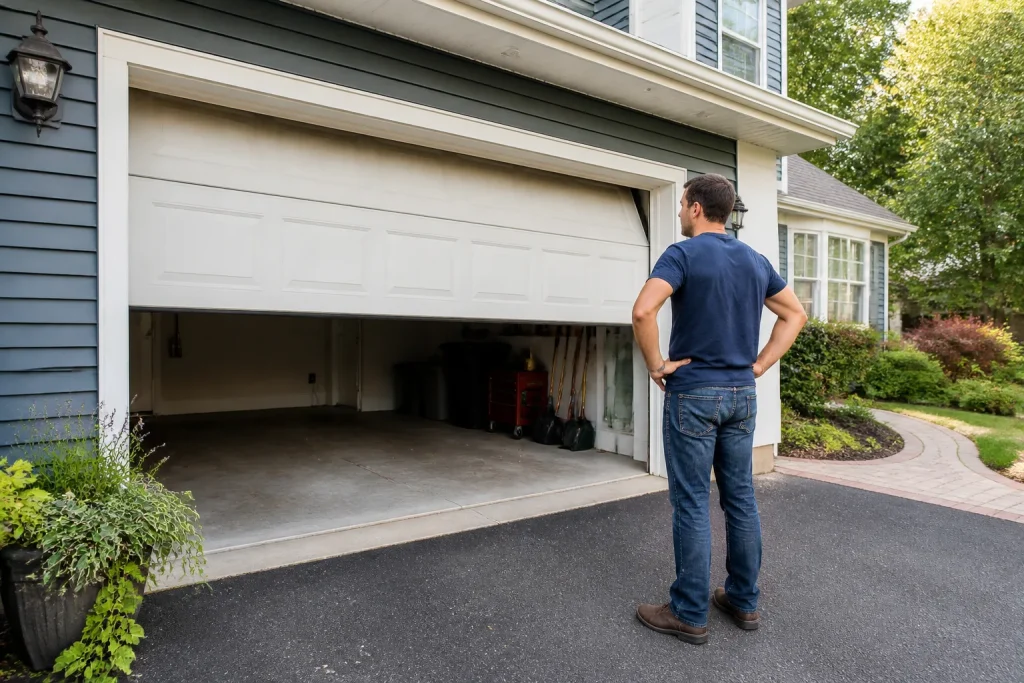
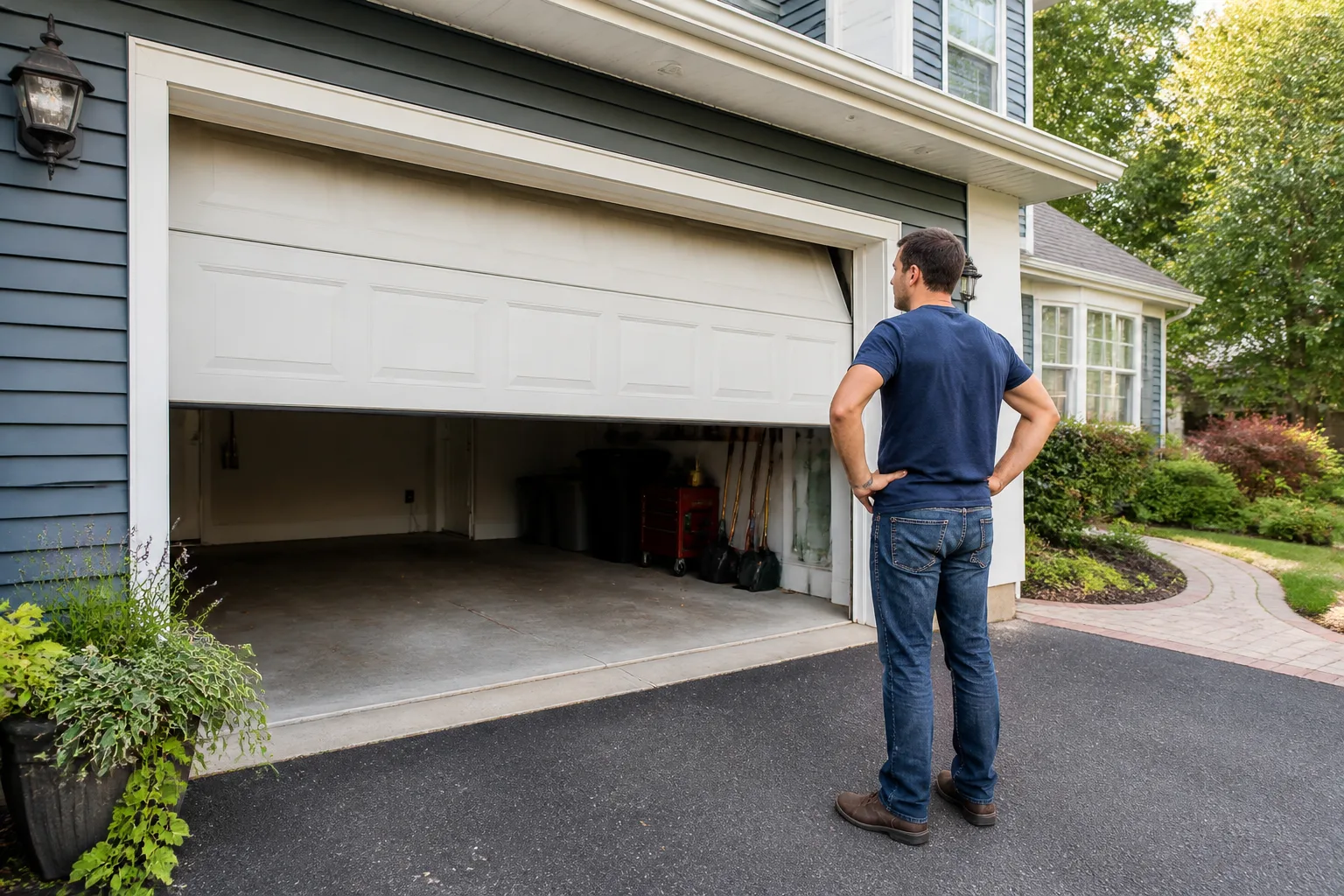
Stand in front of your closed door and look at it straight on. Then open it a foot and look again. Your eyes catch problems a quick glance misses.
- One side higher than the other: a gap of an inch or two means the two sides aren’t lifting together, often a cable tension or drum problem.
- Uneven cable wrap: the cable should wind neatly around the drum. A cable that’s bunched or overlapping is a serious safety concern.
- Rust in a line or a patch: rust patterns show where moisture sits and where metal is wearing against metal. A rust line along the bottom bracket tells you water has been getting in.
Asymmetry is a leading indicator. It shows up before the door refuses to close, and it’s the kind of thing a technician catches in a walk-around. If you see one side lagging, don’t run the door repeatedly to “test” it. Call for service and let someone trained look at the cables and drums. In Edison’s climate, the freeze-and-thaw cycle works metal hard, and a small imbalance tends to grow.
What Are Your Opener’s Behavioral Tells?
Your opener talks to you through small changes in how it behaves. Catching those changes early is how you avoid a dead opener and a car stuck inside.
- Slower cycles: the door takes longer to go up or down than it used to. That’s a motor working against resistance, often a tired spring or a binding track.
- Shorter remote range: your remote works from the driveway but not from the street. A weakening receiver or a failing logic board often shows up here first.
- Intermittent response: the door opens sometimes and ignores you other times. That pattern, before a full failure, usually points to the logic board or a failing safety sensor.
Modern and legacy systems fail differently. A Genie Aladdin or a LiftMaster myQ smart opener behaves one way when its board is going; an older Craftsman unit behaves another. We handle garage door opener repair across both, so the diagnosis fits the unit you actually own rather than a generic guess. If your opener is hesitating, that’s the moment to book a look, before it quits with the car inside.
Why Is a Cracked Bottom Seal More Than a Draft Problem?
A cracked bottom weatherseal looks like a small annoyance. In practice, it’s the entry point for the moisture that corrodes your bottom roller bracket from the inside out. Water wicks under a split seal, sits against the bracket and the bottom panel, and starts rust where you can’t see it. By the time the bracket fails, the panel edge is often damaged too.
Check the seal by running a hand along the bottom edge with the door closed. It should feel flexible and sit flat against the floor. Cracks, hardened rubber and gaps at the corners all mean it’s time to replace it. A new seal is a small job compared with replacing a rusted bracket or a panel, and it’s the kind of maintenance that quietly protects the rest of the door. In Edison, wet winters and humid summers are exactly the conditions that turn a small seal crack into corrosion, so it pays to check twice a year.
When to Call a Pro, and What to Say
Some things you can check yourself: the balance test, the sounds, the visual alignment, the seal. The repairs behind those checks are a different matter. Springs, cables and drums are under extreme tension, and they’re the parts most likely to hurt someone who improvises. If you find a drift in the balance test, a grinding roller, an uneven cable or a door that hesitates, that’s the point to call for garage door spring repair or a full diagnostic, not the point to watch and wait.
Related services in Edison: garage door repair, opener repair, spring repair, and full door installation.
The best move is to describe what you’ve noticed. “It’s slower than it was,” “there’s a grinding on the left side,” “the remote only works up close.” A technician who works on your exact brand, whether that’s Amarr, Raynor, Wayne Dalton or another system, can turn that description into a diagnosis and quote the work before anything begins. Our technicians have up to 11 years of experience with these systems. We quote the price and agree it with you before any work starts, so the written estimate is what you pay.
If your door fails and you’re locked out or locked in, we treat it as the access problem it is. We answer 24/7. Fast dispatch runs 7am-7pm, Sunday through Friday, and a call outside dispatch hours is booked into the next opening. Emergency work is priced per job by the written estimate like everything else. The estimate itself is free.
The Bottom Line
The signs that save you money are the quiet ones: a door that drifts when half-open, a new grind on one side, a remote that’s lost range, an uneven gap at the top. Run the balance test, listen for the three sounds, look for asymmetry, and check the bottom seal. Catch them early and you fix a spring. Ignore them and you fix a spring and a motor.
If you’re in Edison and need help, Edison Garage Door Repair Pros offers free estimates. Call (855) 506-5081 and tell us what you’ve noticed. We answer 24/7, with fast dispatch from 7am to 7pm, Sunday through Friday, and we’re closed Saturday.
Frequently Asked Questions
A door that drifts back down when you let go at half height, feels heavy to lift by hand, or slams when released has weak springs. Run the manual balance test with the opener released to confirm. Don’t attempt spring repair yourself; torsion springs are under extreme tension and can injure you. Call (855) 506-5081 for a free estimate.
Not always, but it’s a warning. Grinding usually means a roller bearing or hinge is failing, and a seized roller can drag the door off its track. Stop running the door if the grinding is constant or loud, and book service. Call (855) 506-5081 and we’ll help you decide how urgent it is.
Often, yes. Common repairs such as opener faults and roller or track issues can typically be handled the same day, depending on parts. We answer 24/7 and run fast dispatch from 7am to 7pm, Sunday through Friday. Call (855) 506-5081 for a free estimate.
No. We quote the price and agree it with you before any work begins, and the written estimate sets the final price. The estimate itself is free. Call (855) 506-5081 to book one.
Written by the team at Edison Garage Door Repair Pros.
Need Garage Door Help?
Call Edison Garage Door Repair Pros - the local pro we connect you with is licensed and insured, here with fast help in Edison.
(855) 506-5081